The short answer
California Fire Code Section 510 requires a building to provide approved radio coverage for emergency responders, and an emergency responder radio coverage system where the building cannot deliver that coverage on its own. Section 510.4.1 sets the pass mark at 95 percent of all areas on each floor and 99 percent of the areas the fire code official designates as critical. Which buildings get evaluated is decided locally rather than statewide: adopted California standards range from two or more levels above grade or 12,000 square feet up to more than three stories or 50,000 square feet. No amplification system operating on frequencies licensed to a public safety agency may be installed without prior coordination and the express written consent of the FCC license holder.
| Code section | CFC Section 510, Title 24 Part 9 |
|---|---|
| Who sets the thresholds | The local fire code official, not the state |
| Coverage pass mark | 95 percent general, 99 percent critical, CFC 510.4.1 |
| Equipment listing | UL 2524 listing, CFC Section 510 |
| Installer license floor | Valid C-7 or C-10 California license |
| Telelink | CSLB #472017, C-7 Low Voltage Systems |
What does California Fire Code Section 510 require?#
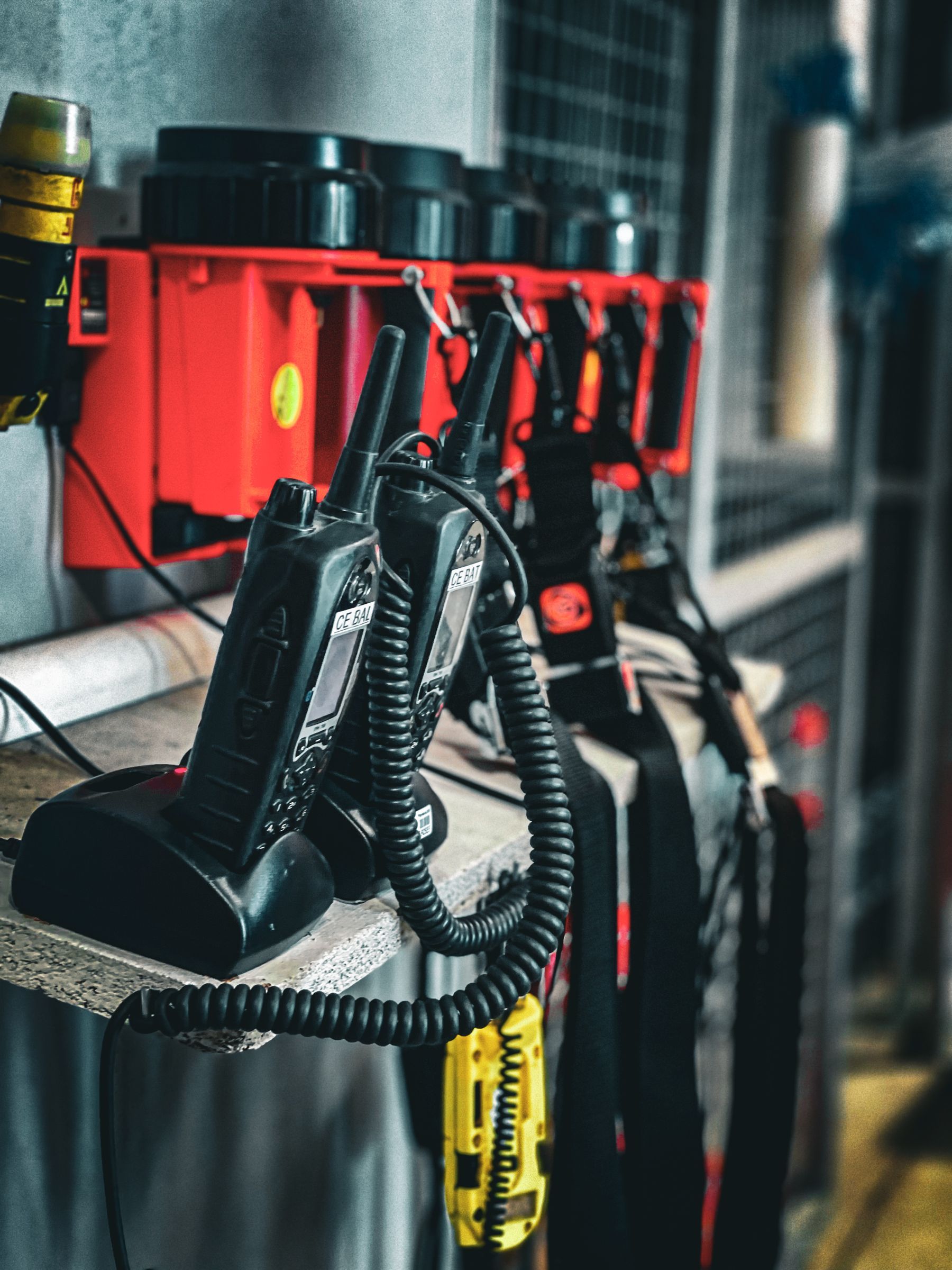
Section 510 of the California Fire Code, Title 24 Part 9, requires a building to provide approved radio coverage for emergency responders inside the structure, measured against the public safety communication system serving the jurisdiction. Where the building cannot deliver it, the owner installs an emergency responder radio coverage system. The abbreviation is ERRCS, and some jurisdictions write it ERCES. The physical system is usually a donor antenna on the roof aimed at the public safety site, a bidirectional amplifier, a distributed antenna network or fiber remote units feeding the areas that fail, and a battery cabinet.
The part that surprises project teams is who decides. Section 510 is enforced by the local fire code official, and California jurisdictions amend and supplement it. What triggers an evaluation, how the acceptance test is run, and which credentials the installing entity must hold are all set locally. Two buildings of the same size in two counties can land in different places.
Treat Section 510 the way you treat a sprinkler design. The code sets the frame and the authority having jurisdiction sets the numbers. Confirm the adopted standard with the fire district before drawings are priced, and get any interpretation in writing from the fire code official rather than from an equipment vendor. If a project turns on a contested reading of a local amendment, ask the fire code official for a written ruling, and bring in counsel if the dispute does not resolve there.
Which buildings need an ERRCS in California?#
Section 510.4.1 supplies the pass mark itself: 95 percent of all areas on each floor and 99 percent of the areas the fire code official designates as critical. What is not statewide is the trigger, meaning which buildings get evaluated at all. The table shows criteria adopted by named California fire authorities. The spread is the point.
| Adopted standard | Buildings evaluated or required | General area coverage | Critical areas |
|---|---|---|---|
| Santa Clara Fire Department guideline | More than 3 stories above grade plane, 30,000 sq. ft. or more, or basement of 5,000 sq. ft. or more | 90 percent | 99 percent |
| City of Long Beach Fire Prevention Requirement 1.043 | More than 3 stories above grade plane, 50,000 sq. ft. or more, basement of 5,000 sq. ft. or more, or a solar photovoltaic system | 95 percent | 99 percent |
| City of Burbank ERRCS regulations | 2 or more levels above grade plane, any basement or level extending below grade plane, or 12,000 sq. ft. or more | 95 percent | 99 percent |
| City of San Diego Standard C-1 | High-rise; 3 or more stories above grade; more than 20,000 sq. ft.; multiple below grade stories or basement over 2,500 sq. ft. | 95 percent | 99 percent |
Two families of criteria are visible. The older pattern evaluates buildings over three stories above grade plane with a high area threshold, and one guideline still in circulation from 2017 carries 90 percent general area coverage, below the 95 percent in Section 510.4.1. The newer pattern pulls the trigger down to two levels above grade or any below grade level with a far lower area threshold. Critical area coverage sits at 99 percent in every California standard reviewed here.
Below grade space matters more than its square footage suggests. A subterranean garage, a basement level, a below grade loading dock or a below grade electrical room will almost always fail a coverage test, and several California standards capture them through a below grade trigger rather than the area threshold. If a garage sits under the building, assume the evaluation applies until the fire district says otherwise. Our parking structures page covers the rest of what a below grade garage needs.
Critical areas are where 99 percent applies. The lists are consistent across California standards and generally include the fire command center, fire pump rooms, interior exit stairs, exit passageways, areas of refuge, elevator machine rooms, lobbies and cars, emergency and standby power rooms, main electrical rooms and fire alarm panel locations, plus anything else the fire code official names.
How is radio coverage tested, and when does it fail?#
The acceptance test is a grid test. Each floor is divided into roughly 20 test areas of about equal size, and a measurement is taken near the center of each.
The code and the local standards set different pass criteria. Section 510.4.1.1 sets a minimum inbound signal level of -95 dBm throughout the coverage area, sufficient for a delivered audio quality of 3.0 or better. Section 510.4.1.2 sets no outbound dBm floor at all: the outbound signal need only be sufficient for a delivered audio quality of 3.0, or an equivalent signal to interference plus noise ratio for the technology in use.
Several California jurisdictions test tighter. A delivered audio quality of 3.4 is a figure commonly adopted by California AHJs rather than a code number, and it appears in the Burbank ERRCS regulations, the Palo Alto Fire Department standard and Sacramento Metropolitan Fire District Fire Prevention Standard 32. Burbank and Palo Alto also apply -95 dBm to the uplink, which the code does not. For digital P25 systems Burbank accepts a signal quality measure at acceptance and annual testing, passing at an SNR or SINR of 20 dB or greater with a bit error rate no worse than 2 percent, and San Diego Standard C-1 uses the same pair.
Testing is done with a portable radio of the type the police and fire departments carry, worn on the hip with a remote speaker microphone, because that is how the radio is used.
The failure mode is a schedule problem, not a technical one. Low emissivity glazing, metal stud framing, spray applied fireproofing, concrete shear walls and metal deck all attenuate 700 and 800 MHz signals, and interior buildout adds more, so a shell that tested acceptable in the summer can fail after tenant improvement. Because the acceptance test measures the finished building, the deficiency is often found within weeks of the certificate of occupancy, when there is no time to design, submit, procure and install a distributed system.
The way out is to test early and test again. A preliminary assessment during design tells the team whether to carry an allowance, and a second reading after the shell closes in tells you whether the allowance was right. Both are cheap against holding a certificate of occupancy while a bidirectional amplifier ships.
What is the design, permit and approval sequence?#
The sequence below is the Sacramento County process published in Fire Prevention Standard 32 and by the county radio system administrators. Other jurisdictions differ in the details, but the shape holds: the radio system operator is consulted first, the design is approved before the permit, and the system is not left energized on a live antenna before final inspection.
- Submit the project basics to the regional radio system administrator and receive the technical criteria for your site.
- Complete the design and submit the plan set to the radio system for review.
- Submit to the local permitting authority for the construction permit, with the radio system approval in hand.
- Install. Fire Prevention Standard 32 states the system shall not be left powered on with the donor antenna connected, except for testing during business hours, until final inspection is complete and the radio system has issued final approval. Commissioning happens on a non-radiating load.
- Request a site identifier from the radio system with as-built details.
- Perform third party evaluation and acceptance testing.
- Receive final approval from the radio system, then close out with the district.
Two scheduling facts follow. The radio system review is a separate approval with its own queue and is not part of the building permit, and the acceptance test is performed by a qualified third party, which is another lead time to carry.
Who must consent before the system is turned on?#
An ERRCS retransmits licensed public safety spectrum. An amplification system capable of operating on frequencies licensed to a public safety agency by the FCC cannot be installed without prior coordination and the express written consent of the FCC license holder. California ERRCS standards restate that rule because it is federal licensing rather than building department jurisdiction, and no local permit substitutes for it.
In Sacramento County that coordination runs through the Sacramento Regional Radio Communications System. The frequency license is held by the County of Sacramento Department of Technology radio communications division, which reviews the design, issues the site identifier and gives final approval after testing. Fire Prevention Standard 32 states that new systems shall not be enabled without prior coordination with the system administration. Other regions have their own system operators, and the operator is the first call on any ERRCS scope. Our public safety radio and ERRCS service page describes that coordination.
What licenses and credentials does the installer need?#
There are three layers, and a bidder needs all three.
| Requirement | What it covers | Where it appears |
|---|---|---|
| C-7 or C-10 California contractor’s license | The installing entity’s ability to contract for the work | Named as the minimum qualification in Sacramento Metro FPS 32, the Burbank ERRCS regulations and Long Beach Fire Prevention Requirement 1.043 |
| FCC General Radiotelephone Operator License | The individual designing, commissioning or testing the RF system | Required of designers and key field personnel by Sacramento Metro FPS 32, Burbank and Long Beach |
| NICET in-building public safety communications, or manufacturer training | Competence on the specific system | NICET IB-PSC levels are named by Burbank. Sacramento Metro FPS 32 and Long Beach accept manufacturer or other nationally recognized certification |
| UL 2524 listing | The equipment that provides the coverage | Required by CFC Section 510. Burbank names bidirectional amplifiers, fiber optic DAS and backup power systems; FPS 32 does not mention it |
Note what the license line does and does not say. A valid C-7 or C-10 is the floor for the installing entity where those standards apply. It is not a statewide ERRCS credential and it does not replace the individual credentials. San Francisco handles ERRCS through the fire department’s fire alarm and signaling systems submittal bulletin rather than a standalone ERRCS standard, which changes the submittal path without changing the licensing question. Check the adopted standard for your jurisdiction rather than assuming the Sacramento rule travels.
Telelink Business Services is a licensed C-7 Low Voltage Systems Contractor, CSLB License #472017. Fire alarm work sits outside the C-7 classification, so the connection between the ERRCS and the fire alarm control unit is performed by the project’s C-10 fire alarm contractor. Our C-7 license article covers that boundary.
What does the owner owe after occupancy?#
Three obligations survive the certificate of occupancy.
Standby power. California Fire Code Section 510 sets the floor at standby power capable of operating the system at 100 percent capacity for not less than 12 hours, and several jurisdictions require more. Burbank requires a dedicated storage battery sized for at least 24 hours at 100 percent system capacity, or a generator paired with a battery sized for at least 12 hours, and the Palo Alto standard requires an uninterruptible power supply sized for not less than 24 hours. Confirm the adopted figure before sizing the cabinet, because it drives wall space and weight.
Supervision. California Fire Code Section 510.4.2.5 requires automatic supervisory signals for loss of normal AC power, failure of the battery charger, low battery capacity at a 70 percent reduction of operating capacity, malfunction of the donor antenna, failure of an active RF emitting device, oscillation of an active RF emitting device, failure of critical system components, and failure of the communications link between the fire alarm system and the ERRCS. Those signals annunciate through the fire alarm system.
Annual testing. Fire Prevention Standard 32 requires the owner to hold an annual inspection report conducted within the previous 13 calendar months and have it available for inspection. Under that standard the annual test covers coverage verification, amplifier gain and output verification, a one hour load test or pulse load battery capacity test, and verification that every active component runs on backup power. Owners on state and institutional portfolios usually fold this into the service agreement covering the rest of the low voltage systems, which our government and public works page describes.
Next step#
If a plan check comment put ERRCS on your project, send us the fire district, the building type, the number of levels above and below grade, and any coverage readings you have. We will tell you which adopted standard governs, what the approval path looks like there, and what the scope split is with your fire alarm and electrical contractors. Start at request a bid. General contractors can find our submittal and prequalification process on the for general contractors page.
This article is general information for planning and specification, not a bid, engineering advice or legal advice. Codes and standards change; confirm the current edition with the authority having jurisdiction. Scope and price for a specific building come only in a written proposal.