Service
Cabling Testing, Certification and Infrastructure Audits
For IT directors, facility managers and general contractors who need cabling proved rather than assumed: permanent link certification to the TIA limits, fiber loss and OTDR testing, end face inspection, and a documented audit of a building whose cabling records were lost years ago.
No obligation, and we will say so if the work is outside our license.
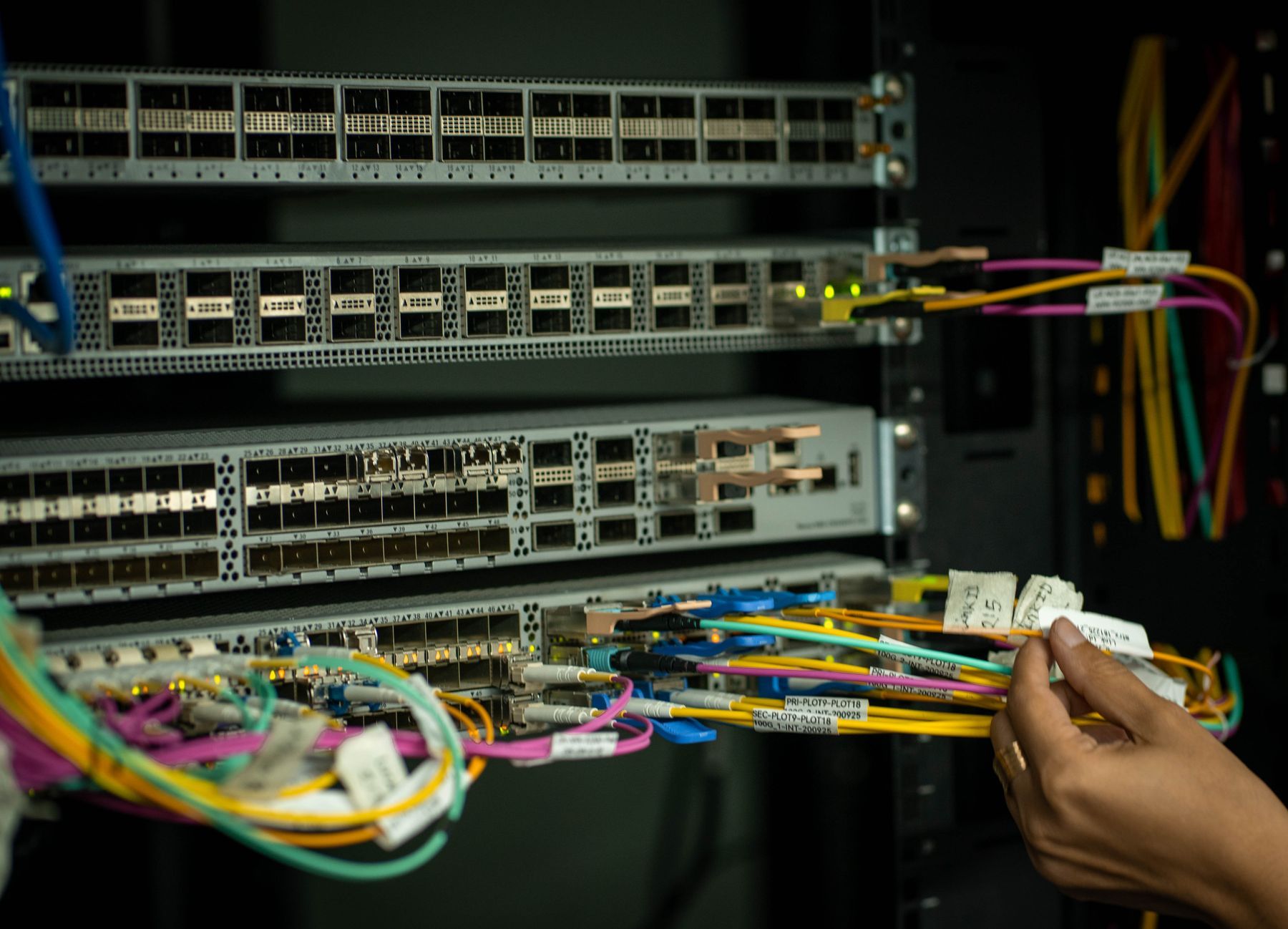
What cabling certification testing proves#
A cable that lights a switch port is not a cable that passed. Certification measures each link against the limits published in the applicable TIA standard and records the measured result, link by link, in a file the owner keeps. It is the difference between a plant somebody believes is good and a plant with numbers attached to it.
We do this work two ways. On our own installations, testing is part of the structured cabling scope and the results ship with the closeout package. As a standalone service, we test and document cabling somebody else installed: a plant the owner inherited, a floor that never got a test report, or a run somebody swears is fine while the switch counts errors. Telelink Business Services is a licensed C-7 Low Voltage Systems Contractor, CSLB License #472017.
Three things get bought under this heading and they price differently: certification of a known plant, diagnostic testing of a short list of links that misbehave, and an infrastructure audit of a building whose records are gone.
Permanent link and channel testing to ANSI/TIA-568.2-E#
Copper testing has two configurations and the spec should say which one it wants. Most Division 27 specs call for permanent link at acceptance, because that is what the contractor installed and what the owner keeps. Channel testing includes the patch cords, which the owner swaps at will. Where a spec names an earlier revision of the standard, we test to the revision the contract names.
| Item | Permanent link | Channel |
|---|---|---|
| What is measured | Fixed cable from panel to outlet, including the connection at each end | The permanent link plus the patch cord and the equipment cord |
| Maximum length | 90 meters | 100 meters |
| Cords used | Reference grade tester cords, excluded from the result | The owner’s own cords, included in the result |
| Crosstalk and return loss | The stricter limits of the two | Looser, because the channel includes the extra connections and cord length |
| Normal use | Contract acceptance and closeout | Troubleshooting a link already in service |
A field tester of the right accuracy class, Level III for Cat6 and Level IIIe for Cat6A per ANSI/TIA-1152-A, set to the right standard and category, checks wire map first and then the transmission parameters: length and propagation delay, delay skew between pairs, insertion loss, near end crosstalk and power sum near end crosstalk, far end crosstalk, and return loss. Each is reported with the margin against the limit and the frequency of the worst case. For Cat6A the spec may also call for alien crosstalk between adjacent links, a separate and much slower test that gets priced when it is required rather than absorbed.
The instrument matters as much as the technician. Field testers carry an accuracy level defined in the TIA field test instrument standard, and Cat6A calls for a higher level than Cat6. The tester needs a current factory calibration, adapters matched to the configuration under test, and a setup that names the standard, the revision, the category and the cable’s velocity of propagation. A report that does not say which limits were applied is not evidence of anything.
What a failing link looks like and what causes it#
Most failures are terminations and most of the rest are pathway. The parameter that fails tells you where to look.
- Wire map: a split pair, a transposed pair, an open from a conductor that missed the punch, or a short from one nicked during stripping. It is a termination, and it is the cheapest failure to fix.
- Length: either the run really is too long, or the tester’s velocity of propagation setting does not match the cable. Check the setting before anyone re-pulls.
- Insertion loss: length, heat, or cable that is not what its jacket print claims. Copper clad aluminum sold as Cat6 fails here and keeps failing.
- Near end crosstalk failing close to one end: too much pair untwist at the jack or the panel, or connecting hardware of a lower category than the cable.
- Return loss: an impedance change along the run. A staple driven tight, a tie wrap cinched into the jacket, a kink from a corner pull, or a bend past the cable’s rated radius.
- Delay skew: mixed pair constructions inside one sheath. That is a cable problem, not an installation problem.
A marginal pass deserves the same attention as a failure. When a result falls inside the tester’s own measurement uncertainty the instrument flags it with an asterisk. We treat a flagged pass as a fail on our own work, and list every flagged result separately on an existing plant, because those are the links that fail two summers later.
Fiber testing: Tier 1 loss, Tier 2 OTDR and end faces#
Fiber is tested to ANSI/TIA-568.3 in two tiers. Tier 1 uses an optical loss test set to measure insertion loss, length and polarity on every strand and compares the result against a budget calculated from the length, the connector count and the splice count. Multimode Tier 1 numbers are only comparable when the launch conditions are controlled, so the test cords are part of the method. Tier 2 adds an OTDR trace on each strand, shot with launch and receive cords, showing every connector, splice, bend and reflective event and where along the fiber it sits. Tier 1 says the link passes. Tier 2 says what is inside it.
Most institutional backbone specs call for Tier 2 and we recommend it where the spec is silent, because the trace is the record that survives a future problem. The splicing and termination work is on our fiber optic cabling page.
Before any of it, end faces are inspected with a video microscope and graded against the zone based scratch and defect limits for the core, cladding, adhesive and contact zones. Contamination is a common cause of high loss on a link that looks perfect, and a dirty connector mated into a clean adapter contaminates both, so inspection happens before every mating.
Auditing a building with no cabling records#
An audit answers a different question than a test report. The owner is not asking whether one link passes; the owner is asking what is in the building, what condition it is in, and what it costs to get to a known state.
We run four passes and deliver a condition report. Rooms and racks: every telecom room located on the plan and photographed, with rack elevations, panel and port counts, a switch inventory, and the condition of the bonding, power and cooling. Pathway: tray, conduit, sleeves and J-hooks traced, checked for fill and sag, rated penetrations checked for firestop. Terminations and labeling: what scheme exists, whether it agrees at both ends, and how much is still legible. A sampled test weighted toward the oldest cable and the areas the owner is worried about. The condition report then says what works, what does not, what has to come out and what a remediation package contains.
A sample proves the condition of a plant. It does not certify it, and we price certification of every link as its own line so nobody finds the difference at closeout. Where the audit finds a room that cannot carry what it holds, the fix is on our network room buildout page. Abandoned cable in the ceiling is a separate scope with its own code driver.
Building a TIA-606 labeling scheme after the fact#
Retrofitting an identification scheme into an occupied building is bookkeeping discipline more than technical difficulty. ANSI/TIA-606 scales the scheme to the site, from a building with one telecommunications room to a multi building campus, so a technician at either end of a cable can find the other end without calling anyone.
Order matters. Agree the scheme with the owner’s IT staff before a label is printed, because a scheme that does not match how they name floors and rooms gets ignored inside a year. Then trace: tone and locate each cable, confirm it at both ends, record the outlet, the room, the panel and the port. Then label, machine printed, at both ends, with designation strips on the panels and engraved plates on rooms and racks. Then test and then draw, so the database and the record drawing carry the same identifiers.
As-built recovery is the same work run backward from the field. We mark every outlet on the architect’s plan as found, reconcile it against the panel, produce the cable schedule, and hand over editable drawings alongside the PDF so the next contractor can add to them. Our guide to MDF and IDF buildouts covers the room side.
What a test report needs to contain to be relied on#
A test report is a contract deliverable on most commercial jobs, and a one page summary saying every link passed is not one. Ours carries the tester make, model, serial number and calibration date; the standard, revision, category and test configuration selected; the cable and connecting hardware actually installed; the date and the technician; and a result for every link with its identifier, its margin, the worst case parameter and the pair combination where it occurred. Failed links appear twice, as the failure and as the retest after rework, so the history is visible instead of overwritten. We deliver the tester’s native database alongside the PDF, because the native file is what an owner’s consultant or the next contractor can reopen, re-sort and re-examine.
Test reports document measured performance against the applicable TIA standard. A manufacturer extended system warranty is a different instrument, issued by the cabling manufacturer rather than the installing contractor, and available only on systems built from that manufacturer’s approved components and installed under that manufacturer’s certified installer program. Where a spec asks for one, the approved component list and the program requirement drive the bid, and we raise it at bid time rather than at closeout. Our Division 27 and Division 28 spec checklist lists the closeout language worth writing into a spec, and the price variables are in our structured cabling cost guide.
Next step#
Send the floor plans, the drop count and the category through request a bid, or tell us the building has no records at all and we will scope the audit instead. The proposal states the test configuration, the standard and revision, the sample size where it is an audit, and the format of the deliverable. General contractors closing out a Division 27 package can review our bid process on the for general contractors page.
FAQ
Questions about testing & audits
Can you certify cabling that another contractor installed?
Yes, and we do it regularly. We test what is there, report exactly what it measures against the standard for the category installed, and list every link that fails or passes inside the tester's measurement uncertainty. What the report certifies is the measurement, and it names the installing contractor of record so the reader knows whose work the numbers describe.
Link to this answerWhat is the difference between permanent link and channel testing?
Permanent link covers the fixed cable and the connection at each end. Channel adds the patch cord and the equipment cord. Acceptance testing on a construction project is almost always permanent link, because that is the part the contractor installed. Channel is the right test when you are troubleshooting a link that is already carrying traffic.
Link to this answerOur building has no cabling records. Where do you start?
With the rooms. We locate and photograph every telecom room, inventory the racks, panels and switches, then trace the pathway and sample the links. The output is a written condition report with a marked plan, not a stack of raw test files, and it tells you what to fix first.
Link to this answerCan you get us a manufacturer warranty on cabling we already own?
Extended system warranties are issued by the cabling manufacturer, cover only that manufacturer's approved components, and require the installer to have been enrolled in that manufacturer's certified installer program at the time of installation. On existing plant of unknown origin, the document that is actually available is a test report against the TIA limits, and on most jobs it is the one the owner needed anyway.
Link to this answerIs a pass with an asterisk acceptable at turnover?
Not on our work. An asterisk means the result sits inside the tester's own measurement uncertainty, so the instrument cannot say with confidence that it passed. We rework and retest those links. On an audit of existing cabling we list them separately, because they are the links most likely to fail in a hot ceiling in August.
Link to this answerQuestion not answered here? Ask a person who does this work.
Call (916) 340-7503Email usOr send drawings to bidReviews
What clients have said
Excerpts from reviews clients left on Google over roughly the last ten years. Most of them describe phone, cabling, camera and service work rather than large construction projects, which is a fair picture of who was writing reviews at the time.
These guys handled my phone and phone system move along with wire our new office from top to bottom. When all others failed, such as AT&T, Telelink was there to pick up the pieces. Most important out of all the great things I could say, they took all my calls and emails, no matter what time of day or night, even on the weekend and holidays. They know what they are doing and get it done right the first time.
U.S. Certified SignersOffice move: phone system relocation and a full office cabling installationI had an issue with my cameras and called for help. He was able to get me on the schedule within the week. They came out, diagnosed the problem, and fixed everything within a couple hours. Very professional, affordable, and fast.
Evan KorisService call on an existing camera systemAfter switching telephone and internet from ATT to Comcast, I needed to have some phone and data lines moved. I called Telelink and immediately received a professional response. An appointment was efficiently scheduled to coordinate with Comcast. The technicians were friendly, capable, and extremely helpful in working through some glitches. After the service, I received an invoice which was honest and very reasonable.
Glick OfficeMoves and changes on phone and data lines, coordinated with the carrier
Reviews are reproduced as written, trimmed only where an excerpt is marked with an ellipsis. Have we worked for you? Tell us how it went.
Planning a testing & audits project? Let’s talk.
Send over a drawing set or just describe what you need. We will tell you what we can take on, what to plan for, and how soon we can be there.