The short answer
There are four ways to put two buildings on one network: trenched or bored fiber in conduit, aerial fiber where poles and permits allow it, a point to point wireless bridge, and a carrier provided circuit. Trenched fiber carries the most capacity and remains the reliability benchmark, but its cost is set by what sits on top of the ground, so the same 300 feet is inexpensive across landscaping you own and expensive across a public street that needs an encroachment permit. A wireless bridge avoids the ground entirely and can be surveyed, installed and commissioned in a fraction of the time, but it requires clear line of sight with Fresnel zone clearance and loses margin in heavy rain at the highest bands. On most projects lead time and permitting decide the question before cost does.
| Four options | Trenched fiber, aerial fiber, radio link, carrier circuit |
|---|---|
| Trench cost driver | The surface on top of it, not the distance |
| Hard gate on radio | Line of sight and Fresnel zone clearance |
| Reliability benchmark | Trenched fiber in conduit |
| Common pairing | Fiber primary with a bridge as diverse second path |
| License | CSLB #472017, C-7 Low Voltage Systems |
Four ways to connect two buildings#
Two buildings, one network, and something between them: a street, a parking lot, a rail spur, a courtyard. There are four real options and they are not interchangeable.
Trenched or bored fiber in conduit. Open cut or bore a path, place conduit with pull boxes, pull outside plant fiber, terminate at each entrance facility. Highest capacity, highest availability, highest one time cost, permanent once it is in the ground.
Aerial fiber where it is permitted. Lash fiber to existing poles. Cheaper and faster than trenching where the poles already run the right way, but it needs a pole attachment agreement and often utility make ready, and the cable is exposed to vehicle strikes, wind and fire. In much of urban California the utilities are underground and the option does not exist.
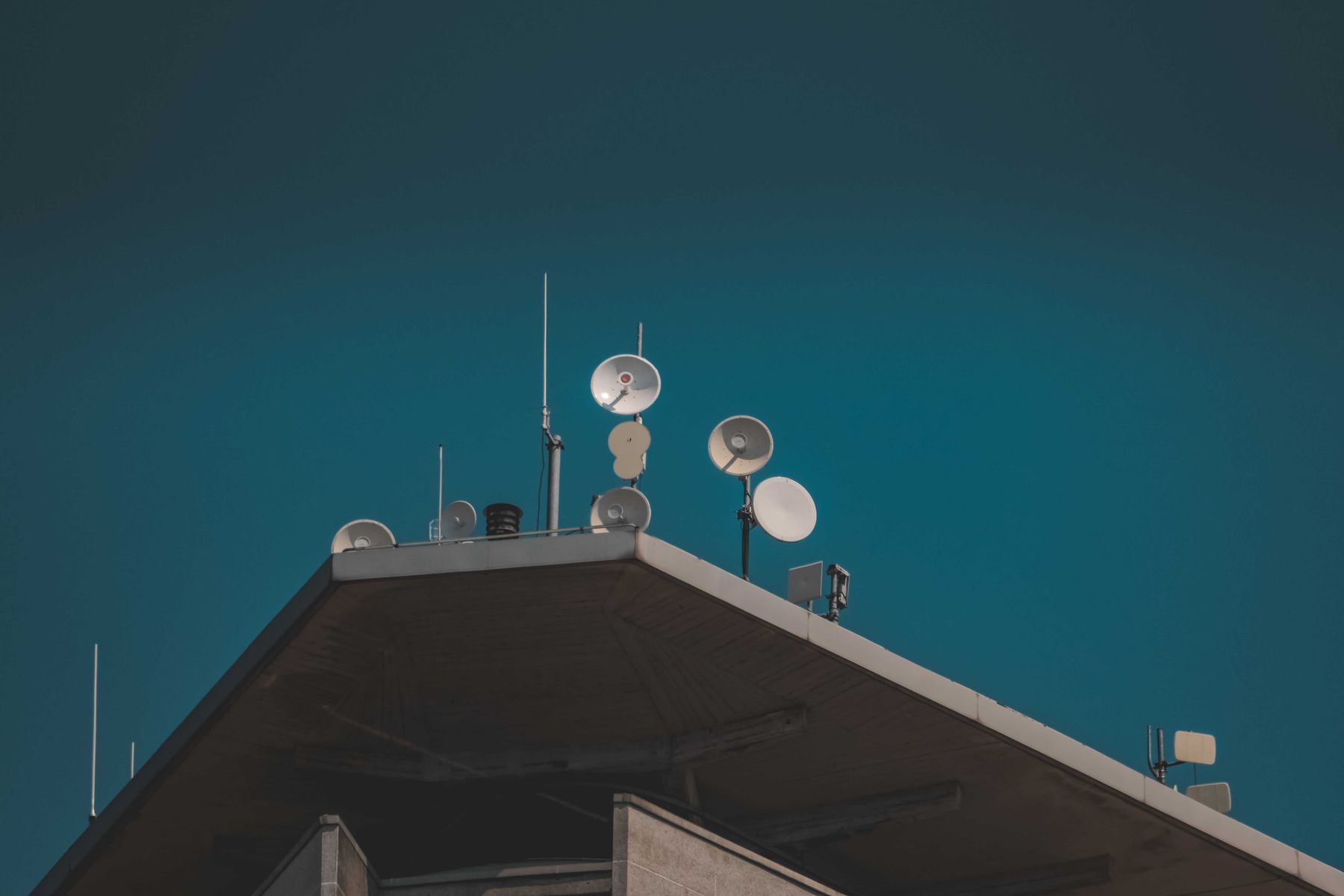
A point to point wireless bridge. A radio on each roof with clear line of sight. Avoids the ground entirely, installs in days once the path is proven, and comes down again if the tenant moves.
A carrier provided circuit. Buy a point to point Ethernet service or dark fiber. Low up front cost, a monthly bill that never ends, and a lead time set by whether the carrier has fiber at both addresses.
Telelink Business Services is a licensed C-7 Low Voltage Systems Contractor, CSLB License #472017. Trenching, boring and underground conduit are civil or electrical scope on most projects. We provide the route, the conduit and innerduct specification, the pull box locations and the entrance detail, and we install and test the fiber or the radio link.
The four options compared#
| Factor | Trenched fiber | Aerial fiber | Wireless bridge | Carrier circuit |
|---|---|---|---|---|
| Cost shape | High one time, set by the surface crossed | Moderate one time where poles exist | Moderate one time at two endpoints | Low up front, monthly for as long as you keep it |
| Lead time | Longest where a permit, bore or easement is needed | Set by the pole agreement and make ready | Shortest, days to weeks after the path survey | Weeks if fiber is at both addresses, months if construction is required |
| Capacity | Set by the optics, upgraded without touching the cable | Same as trenched | Set by band, channel width, path length and interference | Whatever is ordered, changed by contract |
| Availability | Highest, the benchmark | Good, but exposed to strikes, wind and fire | High with fade margin, weather sensitive at 60 GHz | Contractual service level, outside your control |
| Permitting | Encroachment permit, traffic control, restoration, easement | Pole owner agreement, utility make ready | Roof and structural work; FCC station license only on licensed microwave | Carrier handles its own |
| Reversibility | Permanent | Removable | Removable and relocatable | Cancellable, subject to the term |
What a trench costs is what sits on top of it#
The distance between the buildings is the least useful number in the estimate. The surface being crossed and the restoration it requires drive the price.
The figures below are California commercial planning ranges as of 2026, per linear foot of route, for budgeting rather than quoting. They cover the civil work, the conduit and the restoration, not the fiber, the terminations or the testing.
| Surface the route crosses | Planning range per linear foot | What drives it |
|---|---|---|
| Landscaping or unimproved dirt on ground the owner controls | About $20 to $60 | Open cut, backfill, compaction, landscape repair |
| Asphalt parking lot | About $50 to $150 | Saw cut, spoils removal, base, patch, restriping |
| Concrete drive, hardscape or a fire lane that must stay open | About $100 to $300 | Removal and replacement, cure time, phasing to keep access |
| Public right of way or street crossing | About $200 to $600 and up | Encroachment permit, traffic control plan, bore or cut, restoration to city standard |
Those are wide ranges for a reason. On public work, prevailing wage applies to the civil trades as well as ours and moves the whole column. Rock, a high water table, unmarked utilities found on potholing, and a required bore under a protected tree move it further. Utility locating before excavation is not optional in California, and the markings sometimes show that the straight route is unavailable.
What does not vary much is the fiber. On a 400 foot campus link the cable is a small fraction of the project and the strand count barely moves it, which argues for pulling 24 strands rather than 12 while the conduit is open. Our guide on single mode versus multimode fiber covers strand count and fiber type, and our structured cabling cost article covers inside plant ranges.
Lead time and permitting usually decide it#
Cost dominates the discussion, but on most of these projects the schedule is what actually settles the choice.
An encroachment permit to cross a public street is issued by the city or the county, and the timeline is theirs. The application typically needs a plan set, a traffic control plan, insurance, a bond and a restoration commitment to the agency standard. Many California cities also impose a moratorium on cutting a recently resurfaced street, which can force a bore instead of an open cut or push the work out until the moratorium expires. None of that is unusual and none of it is fast.
An easement across land the owner does not control is slower still, because it involves another owner’s attorney and a document recorded against title.
A carrier circuit has its own version of the problem. If the carrier already has fiber at both addresses, delivery takes weeks. If it does not, the carrier has to build to the address, which means it now has the same permit and trench problem you were trying to avoid. Ask in writing whether the address is on net before treating the quoted interval as real.
A wireless bridge is the fast option and that is often the whole argument for it. Path model, roof survey, spectrum scan, equipment, two roof visits, commissioning. Where a schedule needs the second building on the network in six weeks and the permit cycle is six months, the bridge is not a compromise, it is the only option that meets the date.
Capacity, latency and availability compared honestly#
Capacity. Fiber’s capacity is set by the transceivers, not the glass, so an OS2 link installed today carries a higher speed later by changing optics at each end. A radio link’s capacity is set by band, channel width, path length and interference, and raising it means new radios. A carrier circuit’s capacity is whatever is on the order form.
Latency. Over campus distances the propagation difference between fiber and a radio link does not matter. Variability does. A radio link under interference retransmits, and retransmission shows up as jitter long before it shows up as lost throughput. A carrier circuit’s latency depends on the path the carrier actually takes, which can be far longer than the straight line.
Availability. Trenched fiber in conduit is unaffected by rain, fog, foliage or a new building going up in the path. What takes it out is excavation, usually equipment digging into the conduit. A well engineered licensed microwave link is highly available, with exclusive coordinated spectrum and protection from interference, and is the closest a radio gets to fiber. An unlicensed link in a crowded band sits below that, because the interference floor changes when a neighbor installs a radio. Trenched fiber is still the benchmark.
At Touro University in Vallejo, the campus building renovation included a fiber backbone between buildings. Controlled ground, a service life measured in decades and uplink requirements that keep climbing: fiber was the correct answer there and a radio link would have been wrong. Our fiber optic cabling page covers that side of the work.
Line of sight, Fresnel clearance and rain fade#
Line of sight is the hard gate on the wireless option, and it means more than seeing the other roof.
A radio link needs the ellipsoidal volume around the direct path kept clear, the first Fresnel zone, and the working rule is at least sixty percent of it free of obstruction. That volume is widest at the midpoint and grows as the path gets longer and the frequency gets lower. A parapet that clears the sight line by a foot can sit inside the zone and cost the link several decibels. So can a rooftop screen, a mature tree, or a tower crane on the neighboring lot. The survey looks at what is planned as well as what is standing.
Weather is the other constraint. Signal at 60 GHz is absorbed by the atmosphere and attenuated further by heavy rainfall, so usable path length is set by the fade margin you want during a storm, not by what works on a clear day. A link engineered to a fair weather distance will drop in a winter storm, so paths get sized to a target availability using regional rainfall statistics. The 5 and 6 GHz bands reach further at lower capacity and are far less weather sensitive; the tradeoff is occupancy, because in a dense area the interference floor sets the rate the link will actually hold.
If the path does not clear, the radio option is off the table and the conversation goes back to fiber or a carrier. That is determined with a path model and a roof visit before anyone buys equipment. Our wireless bridges page covers the survey, band selection, mounting, grounding and commissioning.
Ownership, easements, and using both#
When the two buildings have the same owner and the ground between them is theirs, this is an engineering decision. When they do not, it is a property decision first.
Fiber crossing a parcel the owner does not control needs a recorded easement or a written license, negotiated with a party who has no reason to hurry. A rooftop radio needs roof rights and access at both ends, and on a leased building the lease has to permit it for long enough to justify the equipment. Ask what happens when either building sells. A recorded easement survives the sale; an accommodation from a friendly neighbor does not.
The two options also combine well. As a temporary link, a bridge brings a newly acquired building, a swing space or a construction trailer onto the network at the pace of a survey rather than a permit cycle. As a diverse second path, a bridge alongside trenched fiber gives real redundancy, because the two fail for unrelated reasons. A backhoe takes the fiber and a storm degrades the radio, and because the two causes are unrelated they are unlikely to occur at the same time. That value only exists if the failover is configured and tested, so the routing gets built and a failover is forced at commissioning. A second path that has never carried traffic has not been shown to work and should not be counted on in the design.
| Situation | Reasonable choice |
|---|---|
| Both buildings on ground the owner controls, route crosses their own lot | Trenched fiber in conduit |
| Public street between the buildings, encroachment permit measured in months | Wireless bridge now, fiber priced as a later phase |
| Campus with a long service life, controlled ground and rising uplink needs | Trenched fiber, strand count sized for the next decade |
| Leased building with two years left on the term, or a construction trailer | Wireless bridge |
| No line of sight and the obstruction cannot be removed | Fiber or a carrier circuit; the radio is off the table |
| One link that cannot go down, and budget for two paths | Fiber as primary, bridge as the diverse second path |
| Third party land in between and no easement obtainable | Carrier circuit, or a radio link over the parcel |
| Cameras in the remote building recording to a head end in the main building | Total the sustained streams first, then choose |
That last row is the one people skip. Cameras writing continuously to a recorder in the other building put a floor under the link that does not go away at night. Total the streams at their configured bitrate, add headroom, and choose from that number rather than the switch port speed. Our security camera systems page covers those bitrates.
Next step#
Send the addresses of both buildings, a site plan or an aerial image with the two roofs marked, and the bandwidth the link has to carry through request a bid. We will run the path model, tell you whether a radio link is realistic before anyone buys equipment, and price the fiber route alongside it. Because this link touches the civil, roofing, structural and electrical scopes, the coordination sequence we work to is set out on the for general contractors page.
This article is general information for planning and specification, not a bid, engineering advice or legal advice. Codes and standards change; confirm the current edition with the authority having jurisdiction. Scope and price for a specific building come only in a written proposal.