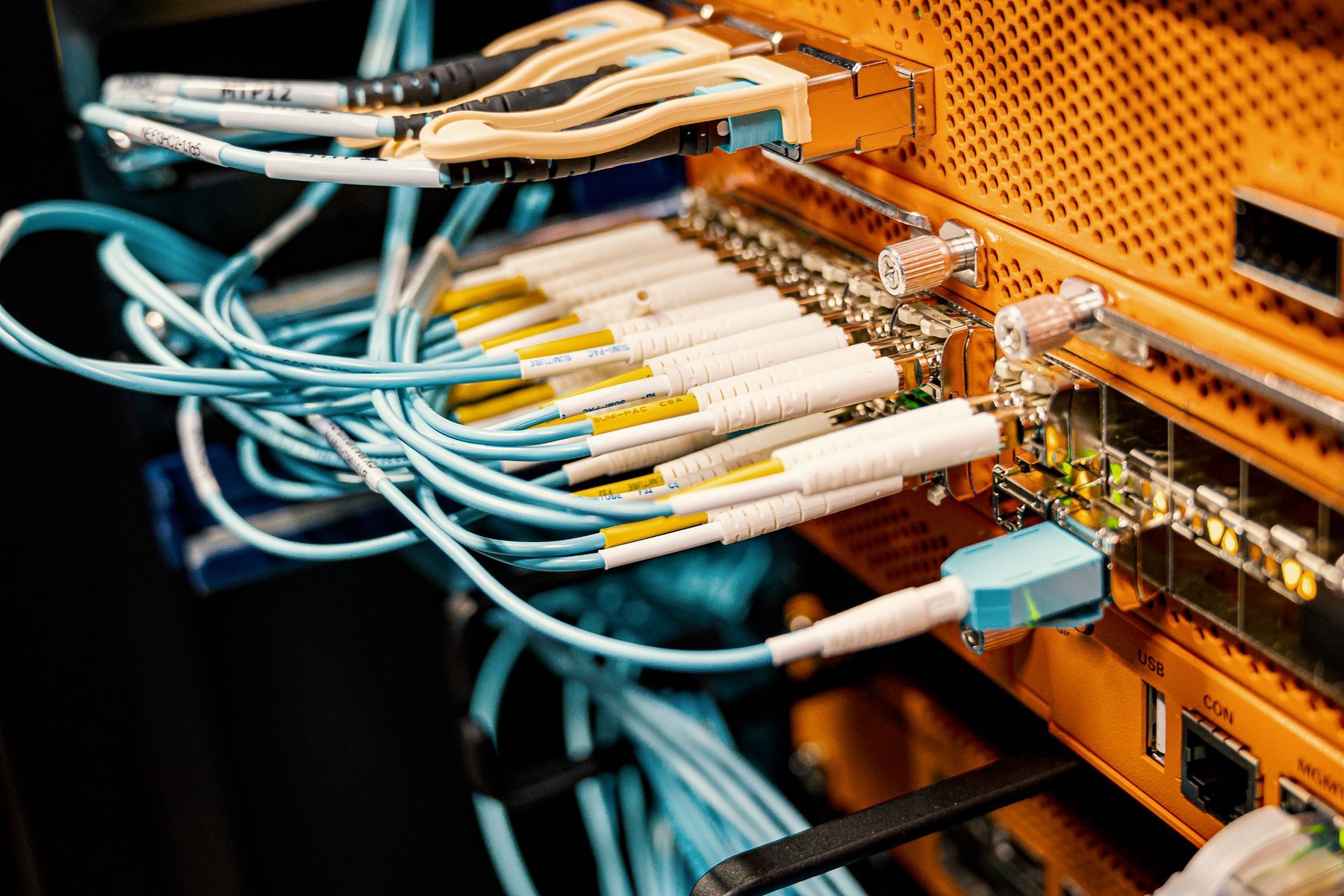
The short answer
As a California commercial planning range as of 2026, an indoor riser fiber link of 12 to 24 strands between an MDF and an IDF runs roughly $2,500 to $6,000 installed, spliced and tested, while a campus link between two buildings runs roughly $25,000 to $150,000 and up. The gap is the pathway, not the glass: on an outside plant run the fiber cable itself is commonly 8 to 12 percent of the total, and the trench is most of the rest. Trenching runs about $20 to $60 per foot through landscape, $50 to $150 per foot through asphalt that has to be restored, and $60 to $250 per foot for a directional bore under a road, so the surface being crossed decides the number more than the strand count does.
| Indoor riser link | About $2,500 to $6,000 per link, 12 to 24 strand |
|---|---|
| Campus outside plant link | About $25,000 to $150,000 and up |
| Trench, landscape | About $20 to $60 per foot |
| Trench, asphalt restored | About $50 to $150 per foot |
| Fusion splice to pigtail | About $40 to $120 per strand |
| License | CSLB #472017, C-7 Low Voltage Systems |
What a fiber link costs, component by component#
Fiber is priced by the component, then assembled into a link and a route. The figures below are California commercial planning ranges as of 2026. They are for budgeting, not for quoting.
| Component | Planning range | Note |
|---|---|---|
| Indoor riser or plenum cable, 12 to 24 strand, furnished and pulled | $3 to $9 per foot | Plenum rated cable is at the upper end |
| Outside plant cable, armored or gel filled, 24 to 48 strand, furnished and pulled | $4 to $10 per foot | Strand count moves this line less than pathway does |
| Fusion splice to a factory pigtail | $40 to $120 per strand | Lowest and most consistent loss; the default on backbone work |
| Pre terminated MPO trunk with breakout cassettes | $1,500 to $6,000 per link | Fast where lengths are known and the pathway takes the connector bundle |
| Rack mount or wall mount enclosure with adapter panels | $300 to $1,500 each | Sized with spare capacity |
| Tier 1 optical loss test, both wavelengths, per strand | $15 to $50 | Insertion loss, length and polarity against the loss budget |
| Tier 2 OTDR trace, per strand | $25 to $90 | Shows every connector, splice and bend as an event |
| Innerduct pulled into existing conduit | $2 to $6 per foot | Protects the cable and reserves space for a second pull |
| Prove and rod existing conduit with mandrel and pull line | $3 to $10 per foot | Cheapest pathway there is, when the duct is clear |
| Pull box or vault, installed | $1,500 to $6,000 each | Required at intervals and at changes of direction |
| Trench and backfill, landscape or dirt | $20 to $60 per foot | Civil scope on most projects |
| Trench, backfill and restore asphalt | $50 to $150 per foot | Saw cut, spoil haul and patch drive the number |
| Saw cut and restore concrete sidewalk or slab | $75 to $250 per foot | Slowest surface to cross and restore |
| Directional bore under a road or hardscape | $60 to $250 per foot | Often cheaper than restoring what a trench destroys |
Trenching, boring and underground conduit are usually civil or electrical scope rather than low voltage scope. They appear here because an owner budgeting a campus link needs the whole number, not the part that lands on one subcontract.
The trench is the number, not the fiber#
Compare two lines from the table at the same length. Six hundred feet of 48 strand armored outside plant cable, furnished and pulled, is about $2,400 to $6,000. Six hundred feet of trench through a restored asphalt drive aisle is about $30,000 to $90,000. The glass is a rounding error against the ground it crosses.
That has three practical consequences for a budget.
Survey the existing conduit before designing a route. Proving and rodding an existing duct is $3 to $10 per foot against $20 to $250 per foot to make a new one. A collapsed duct found on pull day is a schedule problem for everyone, so the mandrel goes through before the cable is ordered, not after.
Route around expensive surfaces. A route that adds two hundred feet of landscape to avoid eighty feet of concrete plaza is usually cheaper and always faster. The shortest route on a site plan is rarely the cheapest route on the ground.
Install more strands than the day one need. Strand count barely moves the cable line and does not move the pathway line at all. Twelve strands where four are needed, or 48 where 24 are needed, costs a little more in cable and nothing in trench, and it avoids a second pull through a pathway that cost tens of thousands of dollars to create. Terminate what is needed now and leave the rest coiled and documented.
Indoor riser versus campus outside plant#
| Item | Indoor riser link, MDF to IDF | Campus link, building to building |
|---|---|---|
| Typical length | 100 to 300 ft | 300 to 2,000 ft |
| Fiber type | OM4 or OS2, priced both ways where the spec allows | OS2 |
| Strand count | 12 to 24 | 24 to 48 |
| Cable listing | Riser OFNR or plenum OFNP per CEC Article 770 | Outside plant, transitioned at the entrance |
| Pathway | Existing sleeves, shaft and tray in most buildings | New conduit, innerduct, pull boxes, trench or bore |
| Pathway share of link cost | Roughly 10 to 30 percent | Roughly 60 to 85 percent |
| Termination | Fusion splice to pigtails at both ends | Fusion splice to pigtails at both ends |
| Testing | Tier 1, plus Tier 2 where specified | Tier 1 and Tier 2 |
| Planning range per link | About $2,500 to $6,000 | About $25,000 to $150,000 and up |
The indoor figure matches the backbone line in our structured cabling cost guide and the cable drop estimator, where a 12 strand backbone run between an MDF and an IDF is carried at $2,500 to $6,000 terminated and tested. Riser links are predictable because the pathway usually exists. Campus links are not, because the pathway usually does not.
Termination method, strand count and optics#
Fusion splicing to factory pigtails gives the lowest and most consistent loss per termination and is the default on backbone and outside plant. It is priced per strand, so the terminated strand count, not the installed strand count, sets the line.
Pre terminated MPO trunks land as a fixed price per link rather than per strand. They install fast and test predictably, but the length has to be right before the order is placed, and the pathway has to accept the pulling grip and the connector bundle. On a riser with known floor to floor distances, that trade often pays. On an outside plant run through a duct of uncertain condition, it rarely does.
Optics. Multimode optics at 10 Gb/s cost less than single mode optics at the same speed, though the gap has narrowed. OM4 supports 10 Gb/s to 400 meters. OS2 has no practical distance limit inside a campus and stays usable at 40 and 100 Gb/s. Where a specification leaves the choice open, both are priced so the owner can weigh optics cost against the service life of cable that will sit in a duct for twenty years. The switch optics themselves are network electronics, not cabling scope, and are budgeted separately.
Loss budget. Every link is calculated before cable is ordered: cable attenuation for the length, plus the connector and splice allowances the specification adopts, commonly up to 0.75 dB per mated connector pair and up to 0.3 dB per splice, compared against the power budget of the optics. Check those allowances against the edition of ANSI/TIA-568.3 the project actually cites, because connector loss values have changed between editions. A link that does not close with margin gets redesigned on paper, which costs nothing, rather than after the pull, which costs a great deal.
Testing, documentation and prevailing wage#
Tier 1 testing with an optical loss test set measures insertion loss, length and polarity on every strand and compares the result against the calculated budget. Tier 2 adds an OTDR trace showing every connector, splice and bend as an event along the strand, which is what catches a bad splice hiding inside a link that passes its total loss. Most institutional and public agency specifications require Tier 2 on the backbone.
Together, Tier 1 and Tier 2 run about $40 to $140 per strand. On a 24 strand terminated link that is roughly $960 to $3,360, a real line but a small one against the pathway. The output is a record per strand in the native tester format and as PDF, with labels matching the enclosure and the drawing, delivered with the as built route drawing and the splice records. Skipping Tier 2 saves a few hundred dollars now and costs a day of locating when a strand goes dark in five years.
Prevailing wage raises labor, not material. The labor share of an installed line is an assumption rather than a measured figure; carried at about 60 percent, a determination that raises the wage about 40 percent moves that line about 24 percent, not 40. Splicing, testing and civil lines carry a higher labor share and move further; cable and enclosure lines carry more material and move less. Our page on prevailing wage and DIR registration covers the classification and documentation side.
A worked example: a 600 foot two building campus link#
Assumptions: two buildings on one campus, 600 feet between entrance facilities, 48 strand armored OS2 outside plant cable, route crossing 380 feet of landscape and 120 feet of asphalt drive aisle with 100 feet of existing conduit reused at the building ends, two new pull boxes, 2 inch conduit with two innerducts, fusion splice to pigtails on 24 strands at each end with 24 strands left dark and coiled, rack mount enclosures in both entrance rooms, Tier 1 and Tier 2 testing on all terminated strands, private owner, no prevailing wage, trenching performed by the site contractor under the general contractor.
| Line item | Quantity | Planning range | Extended | Scope |
|---|---|---|---|---|
| Trench, backfill, conduit and innerduct through landscape | 380 ft | $20 to $60 per ft | $7,600 to $22,800 | Civil |
| Saw cut, trench, backfill and restore asphalt drive aisle | 120 ft | $50 to $150 per ft | $6,000 to $18,000 | Civil |
| Pull boxes, installed | 2 | $1,500 to $6,000 | $3,000 to $12,000 | Civil |
| Prove and rod existing conduit at both building ends | 100 ft | $3 to $10 per ft | $300 to $1,000 | Low voltage |
| 48 strand armored OS2 cable, furnished and pulled | 600 ft | $4 to $10 per ft | $2,400 to $6,000 | Low voltage |
| Fusion splice to pigtails, 24 strands at each end | 48 splices | $40 to $120 | $1,920 to $5,760 | Low voltage |
| Entrance enclosures, adapter panels, transition and bonding coordination | 2 | $500 to $2,000 | $1,000 to $4,000 | Low voltage |
| Tier 1 optical loss test, both wavelengths | 24 strands | $15 to $50 | $360 to $1,200 | Low voltage |
| Tier 2 OTDR trace | 24 strands | $25 to $90 | $600 to $2,160 | Low voltage |
| As built route drawing, splice records, labeled ports | 1 | $500 to $2,000 | $500 to $2,000 | Low voltage |
| Low voltage subtotal | About $7,100 to $22,100 | |||
| Civil subtotal, priced by others | About $16,600 to $52,800 | |||
| Planning total for the link | About $23,700 to $74,900 |
The entrance enclosure line is not the same item as the enclosure line in the component table. It carries the rack or wall mount enclosure and adapter panels at each end plus the outside plant to listed cable transition at the entrance point and the bonding coordination an armored cable brings with it, which is why it prices above an enclosure on its own.
The fiber cable is $2,400 to $6,000 of a $23,700 to $74,900 link, roughly 8 to 10 percent. The civil work is roughly 70 percent. Every assumption in that list is a lever. Replace the 120 feet of asphalt with a directional bore and the civil line may fall or rise depending on the bore setup cost, but the surface stays intact. Find a clear existing duct across the whole route and the civil subtotal collapses to about $1,800 to $6,000, taking the link with it. Terminate all 48 strands instead of 24 and the splice and test lines double while nothing else moves. Put the job on a public agency campus and, on the 60 percent labor assumption above, a 40 percent determination moves the installed lines about 24 percent.
The Touro University campus building renovation in Vallejo included a campus fiber backbone alongside network cabling, IT room buildout and wireless. That combination, a backbone sized for the next decade of switch uplinks and rooms built to hold it, is what most institutional owners are actually budgeting when they ask what fiber costs. Our fiber optic cabling page describes the design and testing scope, and network room buildout covers the rooms the fiber lands in.
Next step#
Send a site plan with the buildings marked, a backbone riser diagram if one exists, and anything you know about existing conduit between the buildings, through request a bid. What comes back is a route with the pathway priced separately from the cable, fiber type and strand count priced as options where the specification leaves them open, the termination method stated, and the testing tier as its own line. Telelink Business Services is a licensed C-7 Low Voltage Systems Contractor, CSLB License #472017. General contractors can find our Division 27 bid and coordination process on the for general contractors page.
This article is general information for planning and specification, not a bid, engineering advice or legal advice. Codes and standards change; confirm the current edition with the authority having jurisdiction. Scope and price for a specific building come only in a written proposal.