Service
CATV and MDU Distribution: Television and Broadband for Multifamily Properties
For owners, asset managers and general contractors on multifamily and senior housing projects who need every unit to receive television and broadband over cabling the property controls. We design and install the headend, riser and distribution, in-unit outlets, and the coax or fiber plant, and we coordinate with the service provider so the bulk agreement and the wiring match.
No obligation, and we will say so if the work is outside our license.
- CommScope
- Belden
- Corning
We are not tied to any brand. If your drawings call for something else, we install to the specification.
What property-wide distribution includes#
Telelink Business Services is a licensed C-7 Low Voltage Systems Contractor, CSLB License #472017. CATV is one of the systems named in the C-7 classification, and we design and install property-wide television and broadband distribution for multifamily and senior housing across California, including in buildings that stay occupied during the work. Little Tokyo Towers in Los Angeles and Horton House in San Diego both received it, each an occupied renovation where CATV distribution went in alongside property-wide Wi-Fi, cameras and access control.
A multi-dwelling unit (MDU) distribution system has four parts, and the design has to get all four right:
- The headend, where the provider’s signal or the property’s own sources enter the building and are conditioned, amplified, or converted for distribution
- The riser and trunk, the backbone that carries the signal from the headend to each floor or wing
- The distribution, the taps, splitters and amplifiers on each floor that divide the signal to the units
- The in-unit outlets, the drops and wall plates in each living room and bedroom where a television or a gateway connects
Our scope covers all four from the provider’s demarcation point to the last wall plate, plus the pathways, the bonding point coordination, the testing, and the documentation.
Headend, RF and IPTV: how the signal gets into the building#
The headend is the room or rack where the property’s television and broadband begin. What sits in it depends on how the service provider delivers the signal.
RF distribution is the traditional method. The provider delivers a broadband RF signal on coax, and the headend amplifies and conditions it for distribution over the property’s coax plant to every outlet. A television connects directly, or a set-top box does the decoding. It is simple, proven, and the reason coax is still in most buildings.
IPTV delivers television as data over the property’s network. The headend converts the provider’s signal, or receives it as IP already, and each set-top box or smart television pulls its channels from the network over category cable, fiber, or Wi-Fi. IPTV suits buildings that are being wired with category cable or fiber to each unit, senior housing operators who want a property channel for announcements, and any property where the owner wants one plant for television, internet and phone.
Hybrid systems are the common answer in a renovation: a modernized RF headend and riser to serve the existing coax outlets, with a data network beside it for broadband and for IPTV in common areas.
A satellite or off-air headend adds a dish or antenna on the roof, which adds a structural mount, a roof penetration, and a bonding requirement. We coordinate all three with the GC and the electrician.
Riser, distribution and in-unit outlets: RG6, RG11 and fiber#
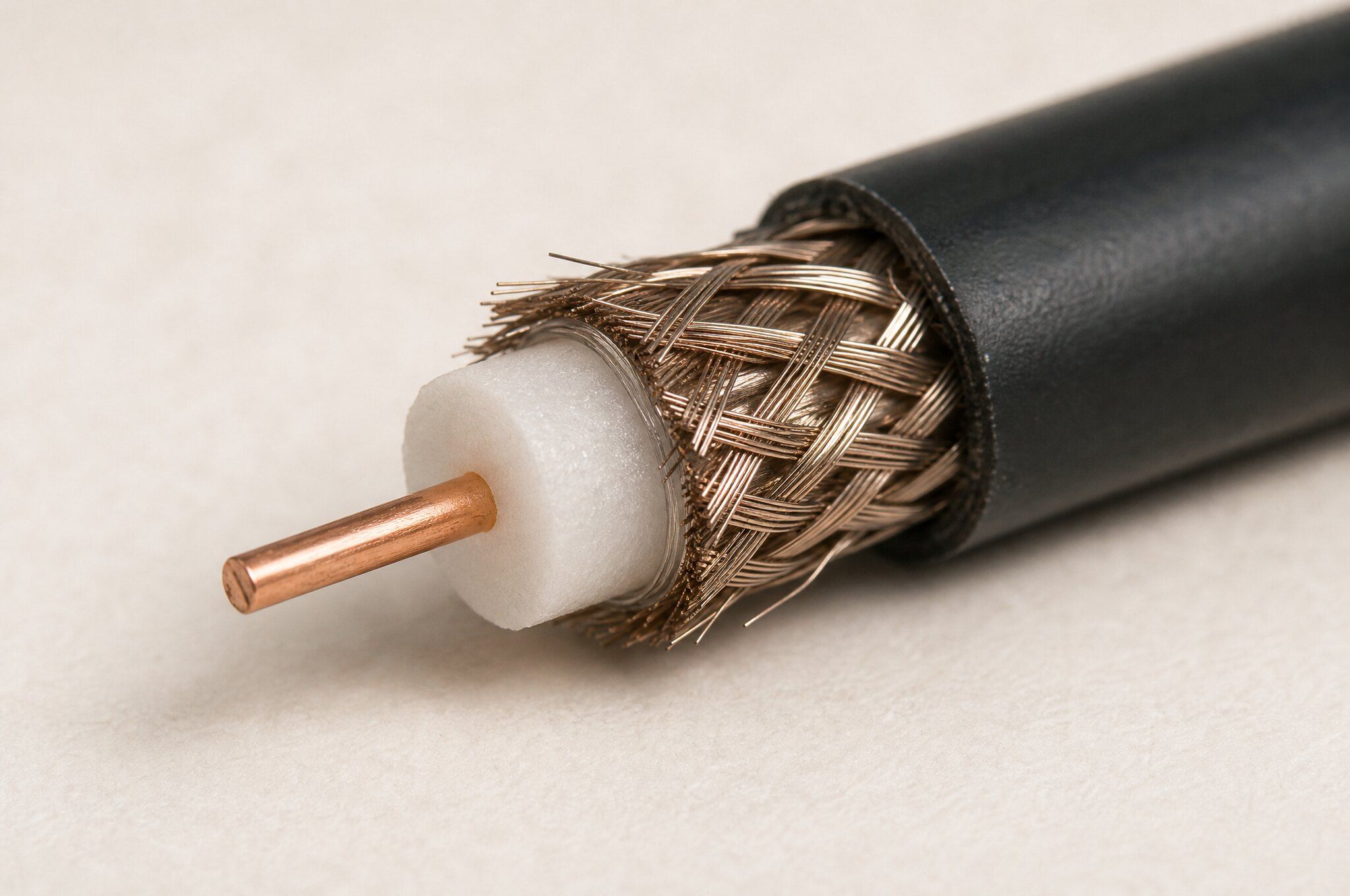
Coax is not one cable. RG6 is the standard for drops from the floor distribution to each outlet: flexible enough to pull through a unit, low enough loss for the distances inside a floor. RG11 is the larger, stiffer, lower-loss cable used for the riser and trunk runs from the headend to each floor, where the distance and the number of splits would starve an RG6 run. RG6 in a riser is a common defect in existing buildings, and it shows up as the top floors getting a weak, noisy picture.
A well-designed coax plant is a set of calculations: the signal level leaving the headend, the loss through each length of cable, the loss through each tap and splitter, and the level that has to arrive at the farthest outlet. Amplifiers are placed where the numbers say, not where there happens to be a closet. Every run is tested for level and for the return path, which is what broadband over coax needs to work, and the results are recorded outlet by outlet.
Fiber to the unit replaces the coax riser and drops with a strand of single-mode fiber to each unit, terminated at a small unit box where the provider’s or the property’s equipment converts it back to television and Ethernet. It is the future-proof choice for new construction and for a full rewire, and it fits with the property-wide fiber backbone we install for Wi-Fi and cameras. See our fiber optic cabling page for how the backbone is designed and tested.
In an occupied renovation the decision is usually to keep the RG6 drops that test clean, replace the riser with RG11 or fiber, rebuild the floor distribution, and replace the headend. That produces most of the benefit of a rewire with a fraction of the time in each unit. Coax and fiber from CommScope, Belden and Corning are commonly specified on the California MDU plants we build, and we install to the named line.
DOCSIS and MoCA in plain terms#
Two acronyms come up on every MDU project, and both describe how data rides on coax.
DOCSIS is the standard that cable providers use to deliver broadband over the same coax that carries television. A gateway in the unit talks to the provider’s equipment through the property’s coax plant, using channels above and below the television signals. For DOCSIS to work, the plant has to carry those frequencies cleanly in both directions, which is why the return path test matters and why an old amplifier with a dead return path breaks internet service on a whole floor while the television still looks fine.
MoCA is a standard for a data network over coax inside the unit or the building. It lets a provider’s gateway in the living room feed a set-top box or a network device in a bedroom over the existing coax, without pulling category cable. MoCA uses frequencies above the television and DOCSIS bands, and it needs a filter at the point of entry so one unit’s MoCA network does not reach into the next unit’s. When a property keeps coax as the in-unit medium, we design the splitters, filters and outlets so that MoCA works in the unit and stops at the unit.
Bulk service agreements and coordination with the provider#
Many multifamily and senior housing owners buy television or internet for every unit under a bulk service agreement and include it in rent or a fee. The agreement decides what the property-side distribution has to carry: RF, IPTV, DOCSIS broadband, a provider-managed Wi-Fi network, or a combination. The provider will also have a specification for what the property’s plant has to look like at the demarcation and often at each outlet.
We ask for the agreement’s technical terms and the provider’s MDU specification before we design, and we build the plant to meet them. We coordinate the demarcation location, the headend space and power, the bonding point, the riser pathways and the outlet standard with the provider’s engineer, and we schedule the provider’s activation in step with our testing so units are not cut over to a plant that has not been proven.
We install and test the property’s side of the system, and the service agreement itself stays between the owner and the provider. That independence is useful to an owner comparing offers, because our plant design is the same regardless of who wins the agreement.
CEC Article 820 and what the inspector looks for#
Article 820 of the California Electrical Code covers community antenna television and radio distribution systems, which is the code’s name for CATV cabling. In plain terms it requires three things that show up on an inspection.
Bonding. The outer shield of the coax entering the building has to be bonded to the building’s grounding electrode system as close as practical to the point of entrance, with a listed grounding block and a bonding conductor sized and routed as the article specifies. That bonding connection to building ground is electrical scope, and we show the location on submittals so the electrician and the inspector are looking at the same drawing.
Listed cable for the space. Coax that runs in a plenum has to carry a plenum listing, cable in a riser shaft has to carry a riser listing, and general purpose cable stays out of both. The listing is printed on the jacket, and an inspector will read it.
Separation from power. CATV cabling is kept out of raceways and boxes that carry power conductors, and separated from them along its route, with the exceptions the article allows. Shared pathways with other low voltage systems are fine; shared pathways with line voltage are not.
The same principles govern the property-wide structured cabling and fiber, under their own articles, which is why one contractor installing all of the low voltage systems on a rehab produces fewer inspection surprises than three.
Working in occupied units#
CATV is the one low voltage system that reaches inside every unit, which makes an occupied renovation a scheduling and communication project as much as a cabling one. Little Tokyo Towers and Horton House were both occupied throughout, and this is the approach we bring to that work:
- Headend, riser and floor distribution first, so the new plant is ready to test before any unit is entered.
- A unit survey by unit type, with property management, to record existing outlets and identify units that need new drops.
- Written notices from property management in the languages the building uses, with an appointment window and a description of the work.
- A small crew per unit, with a property management escort where the program requires it, a drop cloth standard, and a test and sign-off at every outlet before the crew leaves the unit.
- Cutover by floor, with the old service left running until the new plant has passed on that floor.
- An outlet schedule by unit, test results, riser diagrams and headend documentation at closeout.
Our guide to low voltage work in occupied buildings covers noticing and access rules on HUD and LIHTC properties, and the multifamily and affordable housing market page shows how CATV is typically scoped with Wi-Fi, cameras and access control on a rehab.
Next step#
Send us the unit count and building plans, the bulk service agreement’s technical terms or the provider’s MDU specification if you have them, and whether the building will be occupied during the work. Use request a bid to upload drawings and we will return a bid with the demarcation, bonding and headend handoffs drawn. General contractors can start at for general contractors for our prequalification packet.
FAQ
Questions about catv & mdu distribution
Should we install coax or fiber to each unit?
For a renovation with working coax that tests clean, upgrading the riser and the headend and keeping the RG6 drops is often the right spend. For new construction or a full rewire, fiber or category cable to each unit carries television as IPTV and broadband on one plant, and coax becomes optional. The answer depends on the service provider's delivery method and how long the owner plans to hold the property.
Link to this answerWhat is a bulk service agreement and how does it affect the wiring?
A bulk agreement is a contract in which the owner buys television or internet service for every unit at a negotiated rate and includes it in rent or a fee. The provider's delivery method, RF, IPTV or fiber, determines what the property-side distribution has to carry, so we ask for the agreement's technical terms before we design.
Link to this answerCan you rewire units while people are living in them?
Yes. Little Tokyo Towers in Los Angeles and Horton House in San Diego both received property-wide CATV distribution while fully occupied. Riser and headend work is done first, then units are scheduled in noticed appointment windows, with each outlet tested and signed off before the crew leaves the unit.
Link to this answerWhat is MoCA and do we need it?
MoCA is a standard for running data over the coax already in a unit, so a provider's gateway can feed a set-top box or a network device in another room without new cabling. It matters when a property keeps coax as the in-unit medium and the provider delivers IPTV or broadband over it. Whether the property needs it depends on the provider's equipment, and it changes which splitters and filters we install.
Link to this answerWhat does CEC Article 820 require?
Article 820 of the California Electrical Code governs community antenna television and radio distribution cabling. In plain terms, the coax shield has to be bonded to the building's grounding electrode system as close as practical to where the cable enters the building, the cable has to carry the right listing for where it runs (plenum, riser or general purpose), and it has to keep required separation from power conductors. We install to it and the inspector checks it.
Link to this answerQuestion not answered here? Ask a person who does this work.
Call (916) 340-7503Email usOr send drawings to bidReviews
What clients have said
Excerpts from reviews clients left on Google over roughly the last ten years. Most of them describe phone, cabling, camera and service work rather than large construction projects, which is a fair picture of who was writing reviews at the time.
These guys handled my phone and phone system move along with wire our new office from top to bottom. When all others failed, such as AT&T, Telelink was there to pick up the pieces. Most important out of all the great things I could say, they took all my calls and emails, no matter what time of day or night, even on the weekend and holidays. They know what they are doing and get it done right the first time.
U.S. Certified SignersOffice move: phone system relocation and a full office cabling installationI had an issue with my cameras and called for help. He was able to get me on the schedule within the week. They came out, diagnosed the problem, and fixed everything within a couple hours. Very professional, affordable, and fast.
Evan KorisService call on an existing camera systemAfter switching telephone and internet from ATT to Comcast, I needed to have some phone and data lines moved. I called Telelink and immediately received a professional response. An appointment was efficiently scheduled to coordinate with Comcast. The technicians were friendly, capable, and extremely helpful in working through some glitches. After the service, I received an invoice which was honest and very reasonable.
Glick OfficeMoves and changes on phone and data lines, coordinated with the carrier
Reviews are reproduced as written, trimmed only where an excerpt is marked with an ellipsis. Have we worked for you? Tell us how it went.
Planning a catv & mdu distribution project? Let’s talk.
Send over a drawing set or just describe what you need. We will tell you what we can take on, what to plan for, and how soon we can be there.